I thought this was a great blog about the meaning of the Reformation for one person:
From: http://purechurch.blogspot.com/2006/10/reformation-day-reflections.html
Reformation Day Reflections
The Pope of blogging (Tim Challies) has called all bloggers to post reflections on the Reformation and its meaning for us today. In obedience to the pontiff of posts, I thought I’d kiss the ring and share my two cents on so important an observance.What does a German monk nailing a long list of complaints on a church door have to do with an African American ministering in a small, international Caribbean island? Luther’s world and my own couldn’t be farther apart it seems.But on closer inspection, I would not be in Cayman if it were not for that massive Christian church split some 500 years ago. I’ve been thinking a lot about church splits lately… and this one I am quite thankful for. I could wish that the result had been sweeping reform in the Roman Catholic Church. But failing that, I’m thrilled for the recovery of the Gospel.If there had been no recovery of the Gospel of Jesus Christ—the grand promise of justification in the sight of God by grace alone through faith alone in Christ alone to the glory of God alone—I and most African-Americans and Caribbean peoples would likely be utterly and eternally lost today.The greatest miracle of the Reformation is that enslaved Africans heard, above the din of rattling chains and the back-slashing crack of whips, the free Gospel call at the hands of slave traders and many less-than-heroic gospel preachers in the plantation south. That untutored Africans, imprisoned in a foreign land and surrounded by hostile wilderness, heard with clarity the learned oracles of Christ, were spiritually set free, and found the glorious banks of Zion is astounding!However crude, however hampered by their conditions, however assaulted and persecuted by white brothers and sisters in Christ, the Reformation found expression among African descended peoples. There was every earthly reason why it should not have happened. But the one heavenly reason why it should – justification by grace alone through faith alone in Jesus Christ alone – prevailed even among the meanest slaves of the south and the Caribbean.You see… this gospel truly makes everything level at the foot of the cross. The conversion of African Americans and Afro-Caribbean peoples proves this. Despite caste and castigation, slaves came to Jesus! It’s inexplicable apart from the power of the Gospel of Jesus Christ! Why would the master’s Master become the Master of the mastered? Because He is Master of all.Clifton Johnson’s classic collection of slave conversion stories, God Struck Me Dead, makes the point in the slave's own words. One slave recalled:
I saw in a vision, myself in two bodies, a little body and an old body. My old body was dangling over hell and destruction. A voice said to me, “My little one, I have cleansed you of all iniquity. By grace are you saved and it is not of yourself but the gift of God. Weep not, for you are a new child. Abide in me and you need never fear.” I looked in the distance and saw the rejoicing and singing.
I know that I have been dug up and made alive and my soul made satisfied. (God Struck Me Dead, p. 48).The slave understood God’s sovereignty in election (and all things for that matter) in a way that many of us still fail to grasp:
He (God) spoke to me once after I prayed and prayed trying to hurry Him and get a religion. He said, ‘I am a time-God. Behold, I work after the counsel of my own will and in due time I will visit whomsoever I will (p. 7).Another convert tells a similar story: “I began to pray for my soul more and more and began to hurry God. He gave me the gift in His own time. He was drawing me all the time but I didn’t know it” (p. 41).They knew the sovereign election of sinners in their own experience:
I was born a slave and lived through some very hard times. If it had not been for my God, I don’t know what I would have done. Through His mercy I was lifted up. My soul began singing and I was told that I was one of the elected children and that I would live as long as God lives (p. 23; emphasis added).“How can we find God? God has a chosen people. He has always had a chosen people and He calls whomsoever He wills. Any child who has been born of the spirit, knows it for he has felt His power, tasted His love and seen the travail of his soul.”“After I passed through this experience (a vision of Jesus and the city) I lost all worldly cares. The things I used to enjoy don’t interest me now. I am a new creature in Jesus, the workmanship of His hand saved from the foundation of the world. I was a chosen vessel before the wind ever blew or before the sun ever shined.
“Religion is not a work but a gift from God. We are saved by grace and it is not of ourselves but the gift of God” (p. 57).These are the testimonies of field hands at the twilight of chattel slavery. To these we could add the more educated voices of Jupiter Hammon, Lemuel Haynes, Phillis Wheatley and country preacher Joseph Bayesmore (Weldon, NC) and a host of others. As John Saillant put it: “the Calvinism provided the deepest structuring elements of their thought.”The miracle is that the Reformation Gospel came to African America and the Caribbean.The work that’s left before us is to recapture it and to reform our churches according to the Word of God. There’s much to celebrate this Reformation Day… and much work to be done once the celebration is over.
Tuesday, November 21, 2006

Tuesday, November 14, 2006
Interesting Article
http://www.msnbc.msn.com/id/15653706/site/newsweek/
Losing Our Religion
A gathering of scientists and atheists explores whether faith in science can ever substitute for belief in God.
By Jerry Adler (Newsweek) - Updated: 11:43 p.m. CT Nov 11, 2006
Nov. 10, 2006 - The great Danish physicist Niels Bohr, it is said, had a good-luck horseshoe hanging in his office. "You don't believe in that nonsense, do you?" a visitor once asked, to which Bohr replied, "No, but they say it works whether you believe in it or not."
If one thing emerged from the "Beyond Belief" conference at the Salk Institute in LaJolla, Calif. it's that religion doesn't work the same way. Some 30 scientists—one of the greatest collections of religious skeptics ever assembled in one place since Voltaire dined alone—examined faith from the evolutionary, neurological and philosophical points of view, and they concluded that some things only work if you do believe in them. Richard Dawkins, the British evolutionary biologist and author of the best-selling book "The God Delusion," said he couldn't have a spiritual experience even when he tried. After another panelist, neuroscientist V.S. Ramachandran of the University of California, San Diego, explained that temporal-lobe seizures of the brain create profound spiritual and out-of-body experiences, Dawkins disclosed that he had participated in an experiment that was supposed to mimic such seizures—and even then he didn't feel a thing.
Dawkins obviously feels this loss is a small price to pay for freedom from superstition. But even physicist Steven Weinberg, a Nobel laureate and an outspoken atheist, acknowledged that science is a poor substitute for the role religion plays in most peoples' lives. It's hard, he said, to live in a world in which one's highest emotions can be understood in biochemical and evolutionary terms, rather than a gift from God. Instead of the big, comforting certainties promoted by religion, science can offer only "a lot of little truths" and the austere pleasures of intellectual honesty. Much as Weinberg would like to see civilization emerge from the tyranny of religion, when it happens, "I think we will miss it, like a crazy old aunt who tells lies and causes us all kinds of trouble, but was beautiful once and was with us a long time."
To which Dawkins retorted, "I won't miss her at all." Only in the most extreme circumstances would he deign to take account of the consolations offered by religion. He would not, for instance, try to talk a Christian on his deathbed out of a belief in Heaven. He didn't say what he would do if he were the one near death, but it's unlikely he would be calling for a priest. The atheist philosopher Daniel Dennett had been expected to attend, but two weeks earlier had been rushed to the hospital with a near-fatal aortic rupture. At the conference, people handed around copies of Dennett's essay entitled "Thank Goodness," posted on the science Web site Edge.org, in which he described how annoying it was to hear from friends that they had been praying for his recovery. "I have resisted the temptation," he wrote, "to respond, 'Thanks, I appreciate it, but did you also sacrifice a goat?'"
It's hard to be a skeptic, that much was clear from the conference. Hard for the astrophysicist Neil deGrasse Tyson, director of the Hayden Planetarium in New York, who described trying to offer up thanks "to the scientists who made this abundance of food possible" at a friend's Thanksgiving dinner, only to be shouted down by demands for a proper grace. Hard for atheist author Sam Harris ("Letter to a Christian Nation") who likes to point out that people today believe in God based on no more evidence than the ancients had for believing in Zeus or Poseidon—with the result that in addition to all the mail he gets from Christians, he's now getting angry letters from pagans who claim he's insulted their beliefs, as well.
The moderate position at the conference was represented by physicist Lawrence Krauss, who took the view that "science doesn't make it impossible to believe in God, it just makes it possible to not believe in God." The majority view was best articulated by Tyson, who said that atheism is not just the only intellectually coherent position, but a positive boon to humanity. He makes much of the statistic that only 15 percent of the scientific elite in the United States, defined as members of the National Academy of Sciences, express belief in a personal God who takes an active role in the world. That's approximately the mirror image of the population as a whole—but to Tyson, the mystery is that the number of believers among the scientist group isn't zero.
Tyson is a commanding public speaker, which is why his fellow astronomer Carolyn Porco, the head of the imaging team for the Cassini space probe to Saturn, nominated him at the conference to be the first minister of her proposed (although not very seriously) "Church of Science." She thinks science is a perfectly adequate substitute for religion. "Being a scientist and staring immensity and eternity in the face every day is as grand and inspiring as it gets," she says. "No religion offers anything comparable." To the promise of immortality, she counters with the proposition that all the atoms of our bodies will be blown into space in the disintegration of the solar system, to live on forever as mass or energy. That's what we should be teaching our children, not fairy tales about angels and seeing grandma in Heaven. "If anyone has something to replace God," she says, "I think scientists do." Of course, it's not clear that anyone else is looking for one.
Sunday, November 12, 2006
The play is finished
Our last night! Tonight, very sad/happy to be done. I only cried once, so that was less than previously expected.
Thursday, November 09, 2006
Question...
If Joanna had to choose between the following color combinations, which would she choose?
| Black/Silver Red/silver Purple/gold Purple/silver I think she might prefer a red/gold, but since that's not an option, it's been a tough question for me. |
Sorry - long post
I enjoyed Tim's "fresh perspective" and examples about this:
The T in TULIP - Part 1
Yesterday morning my pastor preached on Romans 12-13 under the heading of "Cross-Centered Authenticity." Though I missed much of the first half of the sermon walking the halls with a fussy baby, I returned in time to hear the end of the first (and longest) point and the final four points. I am glad I heard at least the summary of the first point, for it is a critical one. The pastor spoke of how the cross is the great leveller. "All of us have the same disease. All of us have the same problem. So I say the cross levels us. It makes us all equal. We all come to Christ dead in sin; no one is in less need of grace than anybody else and if we feel a kind of clinical detachment from other sinners...then I say to you that you don't understand your own sin."
This fit well with something I have been pondering in recent days. I have felt the desire to write a short series of articles on the Five Points of Calvinism (also known as TULIP), not primarily to rehash the theology of each of the points or to provide an apologetic of Calvinism, but to draw some fresh application as well. I hope to show that these doctrines of grace are more than "mere theology," but can be integral in living out the Christian faith. I am assuming that my readers are, by and large, familiar with the Points of Calvinism. If this proves not to be the case, I will gladly step back and defend them from Scripture. But for now, we will assume at least some knowledge of them.
So let's begin this series (which, unlike several other series I've embarked upon, I hope to actually complete) by discussing Total Depravity, the T of TULIP.
The term "total depravity" has fallen out of favor in recent days, in large part because "total" seems to be a word that confuses, rather than clarifies the doctrine. James Boice and Philip Ryken suggest "Radical Depravity," as does Steve Lawson; R.C. Sproul suggests "Radical Corruption" and Michael Horton goes with "Rebels Without A Cause." Regardless of the terms used, the doctrine reads something like this:
"Total Depravity is a theological term primarily associated with Calvinism, which interprets the Bible to teach that, as a consequence of the Fall of man, every person born into the world is enslaved to the service of sin. In other words, a person is not by nature inclined to love God with his heart or mind or strength, rather all are inclined to serve their own interests over those of their neighbor. Put another way, even with all circumstances in his favor a man without God can do nothing but work for his own destruction; and even his religion and philanthropy are destructive, to the extent that these originate from his own imagination, passions and will" (Wikipedia).
There is a sense in which Total Depravity undergirds the doctrines which follow it (Unconditional Election, Limited Atonement, Irresistible Grace, Perseverance of the Saints). Without Total Depravity, for example, it is possible for God to base election on the condition of a free will choice, thus rendering Unconditional Election invalid.
There is a bounty of biblical support for this doctrine. Genesis 6:5 tells us that "God saw that the intent of every heart was only continual evil." Just two chapters later we read of man that "The intent of every heart is evil from its youth" (Genesis 8:21). Romans 3:10-18 tells us that there is none righteous. There is none who seeks after God. They have all turned aside. Other passages include Isaiah 64:6-7, Jeremiah 17:9, John 3:19, 1 Corinthians 2:14, Ephesians 2:1-3 and 2 Timothy 2:25 and 26. Because the purpose of this article is not to defend this doctrine, I will make no further comment by way of defense.
When we say that mankind fell in Adam, we affirm that as our federal head, Adam's sin was passed on to all of us. Adam represented the human race, and when he decided to forsake God, he did so on behalf of all of us. This is similar to a head of state declaring war on another nation – his declaration means that each person within his nation, each person that he represents, is now at war with the foreign country. Job laments "Or how can he be pure who is born of a woman?" (Job 25:4) No one who has been born of man can escape this radically sinful nature. Nature tells us that like begets like; a dog can only give birth to dogs, not to cats or frogs or birds. Similarly a sinful person can only bring forth other sinful people.
Another affirmation we make in the Christian view of the fall is that there is a sense in which the first sin is ours in the same way in which it was Adam's. While we did not actually take the piece of fruit and eat it, God foreordained our relationship to Adam long before Adam fell so that from the moment of our conception we are sinful. We are not innocent until we commit our first sin, but are condemned, sinful people from the moment our lives begin. Psalm 58:3 tells us that "the wicked are estranged from the womb; They go astray as soon as they are born, speaking lies." Before we are even born we are already sinful, and deliberately go astray as soon as we are able.
And so it is that humans are sinful from the moment life begins. But how sinful are they? We will turn to this now.
As we have seen, many Calvinists are uncomfortable with the term "Total Depravity." Like others, I am convinced that a term such as Radical Depravity or Radical Corruption is superior. I believe these issues contribute to clarifying the matter, for by total depravity we do not mean that people are as depraved as they could possibly be--they are totally corrupt in some ways but not in others. It is here that it is helpful to distinguish between extent and degree.
When we say humans are totally depraved in extent, we mean that their depravity has reached every part of their being. It extends to every part of them – their mind, body and spirit are all corrupt. When we speak of a total degree of depravity, we indicate that something is exactly as bad as it could possibly be so that there is not even a tiny bit of good left.
Consider the illustration of three glasses of water. The first glass contains clean, pure water and represents Adam in his perfect state before the Fall. Now consider a second glass which contains this same clean, pure water. We can put one drop of deadly poison in that glass and it renders that entire glass poisonous so that if you were to drink it, you would quickly drop dead. That one drop extended to every part of the glass even though the entire vessel is not filled with poison. This represents humans after the Fall. While they are not wholly corrupt, the corruption they do have extends to every part. And finally consider a third glass which is filled entirely with poison. From top to bottom there is nothing but deadly poison. This represents Satan, who the Bible portrays as being absolutely corrupt so there is no good left whatsoever, but this does not represent humans here on earth. Humans are not as depraved as they could possibly be. We must note that sinful men who have been cast into hell will also be in this state where they are wholly depraved.
One might ask, then, why God has allowed men who are corrupt in extent not to be corrupt in degree. The reason we find in Scripture is simply that God is merciful. Had He not intervened every human would indeed be corrupt in both extent and degree. If every person in the world were as filled with sin as he could be, the world would be uninhabitable, filled with murderers, thieves and all manner of evil. Thankfully God has allowed even sinful men to avoid being wholly corrupt. There are several means He has given to do this.
Conscience – Every human being has been given a conscience, an inner working which helps restrain the desire to do evil. Paul writes in Romans 2 "...their conscience also bearing witness, and between themselves their thoughts accusing or else excusing them." (verse 15)
Government – God has put civil authorities in place to restrain men from evil. Furthermore, He has given them the authority to dispense justice and punishment. Romans 13 verses 1 through 5 speak to this. "Let every soul be subject to the governing authorities. For there is no authority except from God, and the authorities that exist are appointed by God. Therefore whoever resists the authority resists the ordinance of God, and those who resist will bring judgment on themselves. For rulers are not a terror to good works, but to evil. Do you want to be unafraid of the authority? Do what is good, and you will have praise from the same. For he is God's minister to you for good. But if you do evil, be afraid; for he does not bear the sword in vain; for he is God's minister, an avenger to execute wrath on him who practices evil. Therefore you must be subject, not only because of wrath but also for conscience' sake."
Fear of Death – Humans have a natural fear of death. Every man-made religion emphasizes the necessity of doing good so that we can store up a treasure of good deeds to supposedly sustain us in the life after death. Hebrews 2:14-15 reads "[Jesus] likewise shared in the same, that through death He might destroy him who had the power of death, that is, the devil, and release those who through fear of death were all their lifetime subject to bondage."
Society – People are also restrained by the desire to appear good before their friends, families and society in general. Doing good is generally valued highly enough that people seek to attain to some degree of goodness.
That is the Christian view on depravity. All humans are corrupt in extent – every part of us testifies to our imperfection, but thanks be to God, not in degree. And before us lies a decision. God tells us that when we die we can anticipate either becoming perfected, so once again we will be like that glass of water that is crystal clear, free from any poison of corruption or being cast out of His presence where we will become like that glass of poison, as corrupt and evil and filled with hate as we could possibly be.
In our next article, I'd like to make an application for this doctrine.
The T in TULIP - Part 2
This is the second article in a series dealing with the Five Points of Calvinism and attempting to draw some fresh application from them. I anticipate that each of the five points will merit two articles.
The first article dealing with the T in TULIP can be found here. Today we will seek personal application for this doctrine.
Total Depravity: The Great Equalizer
I often feel that I have a boring or even uninspiring testimony. Like most believers, I have sat through (and sometimes endured) courses, seminars and Bible studies that have taught the value of a good testimony in evangelizing the lost. Many of these have taught evangelistic techniques that begin and end with a riveting testimony, as if God can only save through such a testimony. Of course, like any long-time believer, I have heard some incredible and inspiring testimonies. I have heard about women who were prostitutes giving their lives to the Lord and becoming active in ministry to women. I have met men who were drug dealers, living lives that would cause the most hardened of us to pale, but who were convicted of their sin and, through God's grace, were saved. Compared to these, my testimony seems bland. It seems boring.
My testimony goes something like this: I was born into a Christian home. I was a pretty good kid and never got into any real trouble. Sure I lied a little bit and stole some pocket change from my mother on occasion, but I never did anything really bad. At some point during my teenage years I became a Christian. I do not have a crystal-clear idea of when this happened, but I do know that by the time I graduated high school I was a committed Christian. The end. Not surprisingly, no one has ever offered me a book deal or a spot on the speaking circuit to share that testimony with others.
Rebecca of "Rebecca Writes" fame, once expressed a similar sentiment in an article on her blog. "I came to Christ when I was very young. For almost as long as I can remember, I have been a crooked arrow being made straight rather than a crooked arrow spinning wildly. My testimony doesn't start with 'I was a teenaged prostitute drug-dealing felon, but God saved me.' Nope. 'I was a naughty five-year-old' is about the worst I can do."
In the article Rebecca expresses a belief that I share - Total Depravity is the great equalizer of believers before God. Even when we compare the most sinful man to the young boy who was saved long before he even knew how to get into serious trouble, we see that all men are equal before this law. After all, the Scriptures teach that we are not sinners merely because of the degree of our depravity, but because of the extent. As we saw in the first article on this topic, if we were to speak of a person who was totally depraved in degree, we would mean that the person was exactly as sinful as he could possibly be. Every thought of his heart and every action he undertook would be wholly, completely evil. Clearly there are some people in the world who are more depraved in degree than others and thus the degree of human depravity varies from person to person. This is why we need to distinguish between degree and extent. When we speak of a person who is totally depraved in extent, we mean that every part of that person has been affected by sin. His mind, body, spirit, motives, and thoughts are all corrupt and imperfect. In this measure, all men are equal.
The extent of my depravity is just as great as that of the worst sinner the world has ever known. The thoughts of his heart were continually evil, and so were mine. He hated God, and so did I. I had little opportunity to express this hatred and resentment, yet the Bible teaches that it was there all along. Titus 3:3 tells us that "For we ourselves were once foolish, disobedient, led astray, slaves to various passions and pleasures, passing our days in malice and envy, hated by others and hating one another." These words are as true of a child as they are of an adult. Even a young child passes her days in foolishness, disobedience and malice towards both God and men. There are none who are truly innocent before God.
Ephesians 2:1-3 reads, "And you were dead in the trespasses and sins in which you once walked, following the course of this world, following the prince of the power of the air, the spirit that is now at work in the sons of disobedience--among whom we all once lived in the passions of our flesh, carrying out the desires of the body and the mind, and were by nature children of wrath, like the rest of mankind." Rebecca writes, "Yep, there I was, in the evil band of those marching along the wrong path. I looked innocent enough, with my ringlets and ruffly dress and patent leather shoes, but what you couldn't see is that I, too, was being energized by a spirit ruled by the prince of the power of the air. Yet God, in his mercy, reached down and plucked me from the power of darkness and transferred me to the kingdom of the Son."
Were it not for Scripture's clear teaching on Total Depravity, I may have cause to boast or to consider myself somehow more innocent than a person who instigated and endured much pain and suffering before being drawn to the Lord. Yet the Bible teaches me that my depravity, even as a child, was as great in extent as anyone's. It was only His grace that kept me from being as corrupt in degree. If God delights in saving us, who are depraved in extent, we know also that God can save anyone despite the degree of his sin. If I compare myself to another and find him more in need of a Savior than I, I have made the mistake of comparing my sin to his, instead of comparing my sin to God's perfection. God does not judge us by comparing one to the other, but against His perfect Law.
Before I close, I want to return briefly to those of us with what we perceive to be boring testimonies. It is amazing - shocking really - that the miracle of being delivered from death to life can be considered bland by myself or anyone else. Yet we all love a good story, and my story does not seem particularly exciting. But in reality, I think the testimony of a person, raised in a Christian home, who was saved in childhood is the most exciting testimony we can be privileged to hear. Is it not immeasurably beautiful that God is, indeed, faithful from one generation to the next? He promised the Israelites that He would show "steadfast love to thousands [of generations] of those who love me and keep my commandments." (Exodus 20:6). Perhaps this is best-expressed (as the footnote in the ESV says) as "showing steadfast love to the thousandth generation" of those who love Him. When the child of believing parents is given the gift of eternal life, we can marvel in God's faithfulness to His promises. We can marvel also in His grace, that there are some whom He so blesses so that they do not need to experience such a degree of sin. Truly God is merciful. I pray and plead that He will extend such grace to my children, that they, too, may have testimonies of being drawn to Him while they are still young.
Total Depravity is not mere doctrine, but is truth that should and must impact the believer's life. This truth is the great equalizer, for it shows that the best and worst of men are all equally corrupt in light of God's perfect standard. "The man who looks intently into the perfect law that gives freedom, and continues to do this, not forgetting what he has heard, but doing it–he will be blessed in what he does." (James 1:23) Rebecca writes, "Total depravity is both the nastiest and loveliest of truths, because it's only by seeing exactly what I was that I can understand what has been done for me. Knowing the depth of God's love comes only as I fathom how far he had to stoop to grasp me." God had to stoop just as far to grab me as He did the lowliest criminal, for we were equally dead, equally depraved and equally in need of His grace, His life. We are equal as we fall to our faces before the cross.
We will continue this discussion in the future, as we move to the "U" in TULIP.
Wednesday, November 08, 2006
Monday, November 06, 2006
What it means to be Reformed
I have been investigating Reformed theology for a few years now and found this helpful article.
From here: http://www.challies.com/archives/001926.php
What It Means To Be Reformed
Every year or so I find myself crawling back to a definition of the word Reformed that I first wrote up a couple of years ago. I find it worthwhile to revisit this every twelve months or so. With the amount of reading and studying I do in a year, I feel it is interesting to turn to this definition to see what I would change and what I would refine. I also find it humbling to see which parts of the definition I may have emphasized at the expense of others. And so today I thought I would define the word Reformed, trusting that the readers of this site will find it helpful. While Calvinism and Reformed are not fully synonymous, most people understand them to be so. Because the differences between them are subtle, I will use them synonymously.
It is important to understand that because the Reformed tradition arose from the Protestant Reformation, the term Reformed was not defined from within a void. Rather, it was defined as a biblical response to the excesses and perversions of the Roman Catholic Church. The Reformers, having returned to Scripture, attempted to carefully and faithfully rebuild the church upon the teachings of the New Testament. Thus by affirming Reformed theology, a person is implicitly denying certain other theologies, such as Catholic theology (which Reformed theology rose in opposition to) and Arminian theology (which later rose in opposition to Reformed theology). While Calvinism predates Arminianism, it was only codified in the five points after the rise of Arminianism. There is a sense in which Calvinism is both a cause of and the reaction to Arminianism. Or perhaps we could say that Arminianism is a response to Reformed theology, and the codification of Calvinism is a response to Arminianism.
There are many expressions of the Christian faith that are based at least partially on the teachings of Jesus Christ and the Bible. These are separated into four main divisions: Eastern Orthodox, Roman Catholic, Protestant and Cults. Protestantism can be fairly readily divided into two camps: Arminian and Reformed. The vast majority of Protestants hold to Arminian doctrine. We will concern ourselves today with the minority who consider themselves Reformed. These tend to be people who attend Presbyterian or Reformed Baptist Churches, though they may be found in other churches as well. Sadly, there are many churches that were once Reformed and may still use the title, even if they have long since abandoned the theology.
It is surprisingly difficult to find a worthwhile definition of Reformed. While many people claim to understand the Reformed faith and are eager to provide a definition, few seem to be both fair and adequate. Here are a couple of examples culled from a Google search:
- A term used to refer to a tradition of theology which draws inspiration from the writings of John Calvin (1510-64) and his successors. The term is generally used in preference to "Calvinist."
- Referring to the Reformation, it's theology, and/or those subscribing to it. Also used to differentiate a,) Calvinism from Lutheranism, or b.) Continental European Calvinism from Scottish Calvinism, aka Presbyterianism.
Those are both concise definitions but ones that do not capture the full sense of the word. A far better and more complete definition is found at Five Solas. There Professor Byron Curtis, a professor at Geneva College breaks the definition into four parts which I will expound in some detail. The first two parts define foundational Protestant beliefs and the second two are exclusively Reformed. According to Curtis, to be Reformed is:
- To confess the consensus of the five first centuries of the church:
- Classic theism: One omnipotent, benevolent God, distinct from creation.
- Nicene and Chalcedonian Trinitarianism: one God in three eternally existent persons, equal in power and glory.
- Christ, the God-Man, the one mediator between God & the human race, incarnate, crucified, resurrected, ascended, & coming again.
- Humanity created in the image of God, yet tragically fallen & profoundly in need of restoration to God through Christ.
- The Visible Church: the community of the redeemed, indwelt by the Holy Spirit; the mystical body of Christ on earth.
- The one, holy, catholic, and apostolic church.
- The Sacraments: visible signs and seals of the grace of God, ministering Christ's love to us in our deep need.
- The Christian life: characterized by the prime theological virtues of faith, hope, and love.
It would be correct to say that, to this point, we are dealing with a statement of the Protestant faith more than a statement of the Reformed faith. From this list we see that Reformed Christians adhere to all the foundational beliefs taught in the Bible. These beliefs were the foundation of the early church and are based on the teachings of the Bible as interpreted by the apostles and early church fathers. Many of these beliefs were changed or lost as the Catholic Church grew in power and authority from the fifth century onwards. Throughout history there were isolated and often-persecuted pockets of non-Catholic believers who held to many or all of these points of doctrine, but they were largely lost until their rediscovery at the time of the Reformation.
We will find that Professor Curtis' definition is based largely upon a Presbyterian understanding of several doctrines. Reformed Baptists may take issue with the sacraments being signs and seals. I would suggest that Reformed believers will have a high view of two sacraments, though they may differ somewhat on just how they are to understood and how they are to be administered.
- To confess the four solas:
- The authority of Scripture: sola scriptura (Scripture alone)
- the basis of salvation: Sola Gratia (Grace alone)
- the means of salvation: Sola Fide (Faith alone)
- the merit of salvation: Solus Christus (Christ alone)
Again, these form the basis for Protestantism as much as they do for the Reformed tradition, though sadly the majority of Protestants will never encounter the terms. These are the principles that drove the Protestant Reformation of the 16th century and separated it from the Roman Catholic Church. These four points of doctrine are based entirely on the Bible and were the theological driving force behind the newly formed Protestant movement.
- To confess the distinctives of the Reformed faith:
- In salvation: monergism not synergism. God alone saves. Such monergism implies T.U.L.I.P., the Five Points of Calvinism from the Synod of Dordt:
T = Total Depravity U = Unconditional Election L = Limited Atonement, or, better, Particular Redemption I = Irresistible Grace P = Perseverence and Preservation of the Saints
These five distinct points of doctrine are also known as the five points of Calvinism as they were first articulated by John Calvin after the Reformation was in full-swing. They are based entirely on the Bible. When people speak of being Reformed these five points of doctrine are most often what they are referring to. Most evangelical (non-Reformed) churches do not hold to all of these points. Some hold to two or three (and occasionally even four), but most reject them in favor of Arminian theology which is, at heart, synergistic, relying on a cooperative effort between man and God.
- In salvation: monergism not synergism. God alone saves. Such monergism implies T.U.L.I.P., the Five Points of Calvinism from the Synod of Dordt:
- Other Reformed Distinctives:
Professor Curtis goes on to list other points of doctrine he believes are Reformed distinctives. They include: The Regulative Principle of Worship, Covenant theology (The Church is the New Israel - we most often see an expression of this theology in infant baptism, but it also impacts eschatology and many other doctrines) and Life is religion (Christians have neither jobs nor careers; they have vocations (callings)). I would not consider adherence to these principles necessary to consider oneself Reformed and I suspect the majority of Reformed Christians would agree with me. It is these distinctions that provide some of the differences between Calvinist and Reformed.
- Finally: in everything, Soli Deo Gloria - to God alone be the glory in all things.
This is, once more, something all Christians would claim, either explicitly or implicitly. In all areas of life we are to give glory to God alone.
So what does this all mean? To be Reformed is to adhere to the purist teachings of the Bible - to affirm the doctrine taught by Jesus, Paul and the apostles. Scripture is considered the ultimate authority in matters of life and faith and all Reformed doctrine is founded on the Bible. I am convinced that Reformed doctrine is nothing more than the teachings of Jesus, the Apostles and the totality of the Scriptures. Were it not for human sin we would have to make no distinction between biblical Christianity and the Reformed faith.
If you are interested in learning more about the Reformed tradition, there are many excellent resources availble to you. Here are a few favorites:
- Christian Handbook by Peter Jeffery - an excellent little book I reviewed here that introduces Christian beliefs from a Reformed perspective (A very brief review).
- Putting Amazing Back Into Grace by Michael Horton. This is an excellent, fun introduction to the Five Points (my review).
- Desiring God by John Piper - not for the faint-of-heart but does a great job of explaining Reformed principles (Discerning Reader reviews).
- What Is Reformed Theology? by R.C. Sproul (Discerning Reader reviews).
- The Doctrines of Grace by James Boice (Discerning Reader reviews).
Wednesday, November 01, 2006
It has arrived!
My new car. This is my first car with a key fob with a button that locks/unlocks your doors. I feel ridiculously wealthy. I think this may also be my first car with functioning air conditioning! It is a 1999 Honda Civic! Doesn't that just sound economical? Ahhh. It has about 90000 miles, so just about "broke in" I hope, like a pair of jeans that haven't been washed for a few days/weeks. It is dark (may I say "forrest?") green, a color of car I never thought I would have, but this opens many new names I would have not been able to use if it was a different color. Mi favorito hasta ahora: El guisante verde sabroso. (My favorite so far: The tasty green pea.)
In sad news (for reader #1 of this blog anyway): The Brawny Man was soundly defeated by the Ninja in a recent GoogleFight: http://www.googlefight.com/index.php?lang=en_GB&word1=ninja&word2=Brawny+Man. For such a manly man, he didn't really even show up. The metric system was actually a stronger contender, though still unvictorious: http://www.googlefight.com/index.php?lang=en_GB&word1=ninja&word2=metric+system
In sad news (for reader #1 of this blog anyway): The Brawny Man was soundly defeated by the Ninja in a recent GoogleFight: http://www.googlefight.com/index.php?lang=en_GB&word1=ninja&word2=Brawny+Man. For such a manly man, he didn't really even show up. The metric system was actually a stronger contender, though still unvictorious: http://www.googlefight.com/index.php?lang=en_GB&word1=ninja&word2=metric+system
Tuesday, October 31, 2006
The naming of a car
Yes, details and pictures are coming soon. What is the proper way to name a car? I have been through a process in my car-driving years. All of my cars have had Spanish names, though I am willing to explore other languages for this next vehicle. My first car was "El conjito del amor" (little love bunny - it was red and small, not as scandalous as it sounds!). Then there was El Melocóton Grande (the big peach - a very large peachy-colored Ford). Then, after a string of failure cars I decided to give my next car a Biblical name full of hopeful promise (like God changed Abram's name to Abraham which means "father of many" before he had any children), so my last car's name was "Señor Confiable" - "Mr. Reliable" and well, it lasted three years, so I think it lived up to it's name quite well.
Monday, October 30, 2006
I bought a car tonight!
My first "grown-up" car (i.e. it should be reliable enough to make it to Cedar Rapids, or dare I even say, Des Moines!) but it is hopefully practical enough and not too much "bling" to be immodest or "blingey" Maybe I will have a picture and a name for my new car soon.
Sunday, October 29, 2006
Websites I like
now you know my secret source for articles & such:
purgatorio1.com
challies.com
boundless.typepad.com
purgatorio1.com
challies.com
boundless.typepad.com
Tuesday, October 24, 2006
Science Poem of the Week
Earth’s Embroidery
By Solomon Ibn Gabirol
With the ink of its showers and rains
With the quill of its lightning, with the
Hand of its clouds, winter wrote a letter
Upon the garden, in purple and blue
No artist could conceive the like of that.
And this is why the earth, grown
Jealous of the sky, embroidered stars in
The folds of the flower beds.
This one's for Joanna
I think she will abhor this: www.themissionarygame.com/
I guess I'm not sure what the purpose of this is.... I enjoy math, but it seems to trivialize God's saving grace into a simplistic human-powered equation:
(Uncivilized Pagan) + (Food & Water) + (Bibles) + (Cheery Missionary) = New Christian Convert! Yea!
Ok, maybe I am bitter and disillusioned? Please let me know if you think my heart is hardened.
Sunday, October 22, 2006
Monday, October 16, 2006
A quote for men: seize the day!
"She could but refuse me, and better be a repulsed lover than an accepted brother." - The Lost World by Sir Arthur Conan Doyle
Sunday, October 15, 2006
My life is too boring...
to post everyday! More pirate boot sewing ensues this evening...hehee!
Guess what - Rachna's going to be an aunt!! We are hoping for the name of "Ravulia" for the new child. I also like the name "Ravinashia."
I have some lovely Iowa fall pictures - who would like to see those? You would, really? Maybe tomorrow I will post them.
Guess what - Rachna's going to be an aunt!! We are hoping for the name of "Ravulia" for the new child. I also like the name "Ravinashia."
I have some lovely Iowa fall pictures - who would like to see those? You would, really? Maybe tomorrow I will post them.
Saturday, October 14, 2006
Close to the line!
My clock says 11:20 PM - whew! Not much to report today - lots of play practice, then I went to a haunted house and watched a movie with people I haven't hung out with before much - apparently "operation moving on with life" has officially begun. Well, I think it might have officially begun last week, when we had to take pictures for the play for each of the churches we went to, so they would support/pray for us. I had been attending a new church for all of 4 weeks, but I guess it's "my" church now. I had been attending former-boyfriend's church for the past year, but that was just too hard (operation "get on with life" - not starting).
Friday, October 13, 2006
Any contest that "Nerdy Friday" award belongs to me?
Why do I qualify for the "Nerdy Friday" award?
(1) I spent most of the night sewing pirate boots and
(2) Making lentil soup (yum)
My pirate boots are pretty cool, though.
(1) I spent most of the night sewing pirate boots and
(2) Making lentil soup (yum)
My pirate boots are pretty cool, though.
Thursday, October 12, 2006
Today's Post
In my film discussion group last night we watched a short movie about a current-practice monastery. These were men who were completely devoted to God and loving their brothers as themselves. It was strange though, because many people (the film group being mostly 'protestant' Christians) felt some antipathy or well, something, against these people, myself included! I know my first thought was, "well, why can't I be close to God where I am in my life? I don't need to get away and pray all day!" Why did I feel angry? Was I jealous of the community and devotion these people had? Do I want a faith that is too easy, do I want to have Jesus, but make lots of money and serve only myself? Anyway, I was surprised at my anger, and am not sure why I felt angry. But why aren't there more protestant monks/nuns? Hmmm. Well, if I'm going to post every day, it probably won't all be quality stuff!
Get married, young man!
Ok, so I tried to post this yesterday :( And then again today!! grr. It didn't work, let's see if it does today...
I found this to be a rather compelling article - it's from the link below.
http://www.boundless.org/2005/articles/a0001349.cfm
Get Married, Young Man
by Alex Chediak
Many of us men grew up with a limited picture that being an adult meant independence — being able to live where we wanted, come and go as we pleased, make some money, and see the friends we wanted to see.
Those aspects are certainly part of an adult life, but a key ingredient is missing. I'm not referring to community, accountability, or being involved in a good church. All those things are good, but in and of themselves they just can't function to produce all the blessings that God designs for us. I want to talk very candidly about why a godly wife, for most of us men, will bring blessings that nothing else can.
Perhaps what I've said sounds selfish: finding a wife to "produce blessings" for me. But we all naturally pursue what we think is in our best interest. That's how God has wired us. Sin arises when we seek happiness outside of God, or when we do not prize Him as being greater than any wife could ever be. That kind of attitude can lead to our pursuing good things (like a girlfriend or wife) in ungodly ways (like among non-Christian women or through sexual experimentation).
But I've found that an opposite problem is common today among men — particularly Christian men from good churches: not trying to find a wife at all.
I had that problem myself for a number of years.
The Lord got a hold of my life in some unusual ways when I was in my early 20s. I had plenty of friends through church, and life seemed great. I had lots of free time, plenty of money to eat out, travel and give, and could do what I wanted whenever I wanted. I lived a pretty lax spiritual life in college, not getting into too much trouble but not going hard after God either.
At 23, that changed and I wanted more of God than I had ever had before. I wanted to read theology books, be in as many Bible studies as possible, and know everything about God and His ways that I possibly could.
But the desire for a wife came slowly, and seemed in some ways unnatural. I hadn't been hearing that I needed a wife — after all, wasn't God enough? Didn't Paul say that it was good to remain single, as he was (1 Cor. 7:8)? And that each one should remain in the condition in which he was called (1 Cor. 7:20)? I told myself I could marry if God called me to, but that unless He made that unmistakably clear, I would — and should — stay my bachelor course.
I've known many single guys who think this way. The logic goes like this: "I'm a Christian. I love God. I currently don't have a wife. If God wants me to marry someone, He'll make that explicitly clear. For me to get proactive in the process is to imply that I don't trust God to make it happen. And seeking a wife seems less spiritual than taking on another ministry responsibility. After all, I'm single. I really should commit all my time to God, and not be distracted with thinking about girls."
The problem with this line of thinking is that not every man who has the status of singleness is gifted for singleness. God requires all singles to be celibate until marriage (to abstain from sexual expression in thought and deed), but because most singles aren't gifted for lifelong celibacy, most should seek to marry.
Other writers on Boundless have ably addressed the gift of celibacy and how to discern whether you have it. Briefly, I agree with what they have said in noting that it is a rare gift that is accompanied by a Spirit-endowed ability to cheerfully and without bitterness or rancor abstain from sexual intimacy and the deep emotional companionship that only comes with marriage and having children. In many cases, I believe this is accompanied with a particular life calling that greatly profits from the status of singleness (e.g., missions, a life-threatening vocation, excessive traveling, etc.).
The Scriptures say, "He who finds a wife finds a good thing and obtains favor from the Lord" (Prov. 18:22). So the man is said to "find" a wife, and that a wife is a good thing. The favor from the Lord part shows that, yes, God is the One who ultimately gives the wife, but it is still our job as men to be proactive in the finding process.
In Matthew 19, Jesus gives some very tough teaching on the permanence of marriage. The Pharisees taught that a man could write up a divorce notice to his wife for any reason at all. They chose to put Jesus to the test on the issue. Jesus replies that even though Moses permitted (not commanded) divorce, it was only as an allowance in light of the reality of sin ("... but from the beginning it was not so," Matt 19:8). Instead, Jesus floors them by saying that "whoever divorces his wife, except for sexual immorality, and marries another, commits adultery."
Not only are the Pharisees stunned, the disciples are too. How do we know? Their response is basically "If that's the way it is, Jesus, we should all just stay single!" And, interestingly, Jesus does not dispute their astute observation. Rather, he qualifies it: Yes, singleness has undeniable advantages, but "not everyone can receive this [concept], but only those to whom it is given.... Let the one who is able to receive this receive it."
As a single man in my early 20s, I could not "receive" this. By God's grace, I was not fooling around or hooked on pornography, but I found sexual thoughts and attractive women to be a recurring distraction from my walk with God. Every few months it seemed that a platonic or professional relationship with an attractive non-Christian woman would develop alluring sexual potential. You don't have to date a woman nowadays to get into compromising situations. A single man with strong sexual interests (and that's most of us men) and available sexual encounters (and that's most of us) is in frequent danger.
I've found that protection against sexual sin and the opportunity and the pleasure associated with monogamous sexual intimacy with the woman I love to be a very real benefit of marriage. But there are others.
Marriage enhances my walk with God. Living with my wife forces me to deal with sin issues that were more easily overlooked in my bachelor days. A wife is not very much like a guy roommate — the emotional synergy she will look for from you is far more encompassing. And just because we overlook (or are not forced to deal with) certain sin patterns as singles doesn't mean they aren't there. In fact, one of the dangers of staying single too long is that the quirks we get away with as bachelors can turn into habits that our wives will not appreciate and that we will find hard to break.
It's significant that an elder should be one who manages his own family well (1 Tim 3:4). Paul apparently saw this as a litmus test of how a man will lead in God's church. By trying to love my wife as Christ loves me (sacrificially, intentionally, perseveringly), I am blessed by reaping the good fruit that comes from a joyful partner and friend. Likewise, my failures are amplified because both she and I suffer. Marriage makes me more fully recognize the principles of stewardship.
Finally, marriage calls me to be a provider and protector. I need to be wiser with money, because I'm looking out not just for myself but for my wife and daughter (and the other kids we hope to have). That demands a degree of maturity in me that I don't think I could have mustered any other way.
There's nothing unspiritual about wanting marriage. Marriage is an important, normal, sanctifying, biblical aspect of adulthood. It provides protection from sexual sin, companionship, and the privilege to procreate and give back the gift of life.
Just as it's not necessarily sinful to be discontent and take action if you're unemployed or hungry, God has wired most of us with a longing for the sexual and emotional intimacy of marriage.
Yes, our ultimate and primary satisfaction must be in God, and His purposes can shine forth in our lives regardless of our marital state. Nevertheless, if you're not gifted for singleness, go ahead and seek a wife. You'll be more valuable for the Kingdom of God as a sanctified husband and father than as a single repeatedly getting tripped up with the sexual or emotional struggles common to singleness.
Marriage won't solve all your problems. But your life will generally reflect a deeper maturity and winsomeness that will open doors for relationships and ministry. Know that God's grace will be with you as you step out in faith. Men, what are you waiting for?
I found this to be a rather compelling article - it's from the link below.
http://www.boundless.org/2005/articles/a0001349.cfm
Get Married, Young Man
by Alex Chediak
Many of us men grew up with a limited picture that being an adult meant independence — being able to live where we wanted, come and go as we pleased, make some money, and see the friends we wanted to see.
Those aspects are certainly part of an adult life, but a key ingredient is missing. I'm not referring to community, accountability, or being involved in a good church. All those things are good, but in and of themselves they just can't function to produce all the blessings that God designs for us. I want to talk very candidly about why a godly wife, for most of us men, will bring blessings that nothing else can.
Perhaps what I've said sounds selfish: finding a wife to "produce blessings" for me. But we all naturally pursue what we think is in our best interest. That's how God has wired us. Sin arises when we seek happiness outside of God, or when we do not prize Him as being greater than any wife could ever be. That kind of attitude can lead to our pursuing good things (like a girlfriend or wife) in ungodly ways (like among non-Christian women or through sexual experimentation).
But I've found that an opposite problem is common today among men — particularly Christian men from good churches: not trying to find a wife at all.
I had that problem myself for a number of years.
The Lord got a hold of my life in some unusual ways when I was in my early 20s. I had plenty of friends through church, and life seemed great. I had lots of free time, plenty of money to eat out, travel and give, and could do what I wanted whenever I wanted. I lived a pretty lax spiritual life in college, not getting into too much trouble but not going hard after God either.
At 23, that changed and I wanted more of God than I had ever had before. I wanted to read theology books, be in as many Bible studies as possible, and know everything about God and His ways that I possibly could.
But the desire for a wife came slowly, and seemed in some ways unnatural. I hadn't been hearing that I needed a wife — after all, wasn't God enough? Didn't Paul say that it was good to remain single, as he was (1 Cor. 7:8)? And that each one should remain in the condition in which he was called (1 Cor. 7:20)? I told myself I could marry if God called me to, but that unless He made that unmistakably clear, I would — and should — stay my bachelor course.
I've known many single guys who think this way. The logic goes like this: "I'm a Christian. I love God. I currently don't have a wife. If God wants me to marry someone, He'll make that explicitly clear. For me to get proactive in the process is to imply that I don't trust God to make it happen. And seeking a wife seems less spiritual than taking on another ministry responsibility. After all, I'm single. I really should commit all my time to God, and not be distracted with thinking about girls."
The problem with this line of thinking is that not every man who has the status of singleness is gifted for singleness. God requires all singles to be celibate until marriage (to abstain from sexual expression in thought and deed), but because most singles aren't gifted for lifelong celibacy, most should seek to marry.
Other writers on Boundless have ably addressed the gift of celibacy and how to discern whether you have it. Briefly, I agree with what they have said in noting that it is a rare gift that is accompanied by a Spirit-endowed ability to cheerfully and without bitterness or rancor abstain from sexual intimacy and the deep emotional companionship that only comes with marriage and having children. In many cases, I believe this is accompanied with a particular life calling that greatly profits from the status of singleness (e.g., missions, a life-threatening vocation, excessive traveling, etc.).
The Scriptures say, "He who finds a wife finds a good thing and obtains favor from the Lord" (Prov. 18:22). So the man is said to "find" a wife, and that a wife is a good thing. The favor from the Lord part shows that, yes, God is the One who ultimately gives the wife, but it is still our job as men to be proactive in the finding process.
In Matthew 19, Jesus gives some very tough teaching on the permanence of marriage. The Pharisees taught that a man could write up a divorce notice to his wife for any reason at all. They chose to put Jesus to the test on the issue. Jesus replies that even though Moses permitted (not commanded) divorce, it was only as an allowance in light of the reality of sin ("... but from the beginning it was not so," Matt 19:8). Instead, Jesus floors them by saying that "whoever divorces his wife, except for sexual immorality, and marries another, commits adultery."
Not only are the Pharisees stunned, the disciples are too. How do we know? Their response is basically "If that's the way it is, Jesus, we should all just stay single!" And, interestingly, Jesus does not dispute their astute observation. Rather, he qualifies it: Yes, singleness has undeniable advantages, but "not everyone can receive this [concept], but only those to whom it is given.... Let the one who is able to receive this receive it."
As a single man in my early 20s, I could not "receive" this. By God's grace, I was not fooling around or hooked on pornography, but I found sexual thoughts and attractive women to be a recurring distraction from my walk with God. Every few months it seemed that a platonic or professional relationship with an attractive non-Christian woman would develop alluring sexual potential. You don't have to date a woman nowadays to get into compromising situations. A single man with strong sexual interests (and that's most of us men) and available sexual encounters (and that's most of us) is in frequent danger.
I've found that protection against sexual sin and the opportunity and the pleasure associated with monogamous sexual intimacy with the woman I love to be a very real benefit of marriage. But there are others.
Marriage enhances my walk with God. Living with my wife forces me to deal with sin issues that were more easily overlooked in my bachelor days. A wife is not very much like a guy roommate — the emotional synergy she will look for from you is far more encompassing. And just because we overlook (or are not forced to deal with) certain sin patterns as singles doesn't mean they aren't there. In fact, one of the dangers of staying single too long is that the quirks we get away with as bachelors can turn into habits that our wives will not appreciate and that we will find hard to break.
It's significant that an elder should be one who manages his own family well (1 Tim 3:4). Paul apparently saw this as a litmus test of how a man will lead in God's church. By trying to love my wife as Christ loves me (sacrificially, intentionally, perseveringly), I am blessed by reaping the good fruit that comes from a joyful partner and friend. Likewise, my failures are amplified because both she and I suffer. Marriage makes me more fully recognize the principles of stewardship.
Finally, marriage calls me to be a provider and protector. I need to be wiser with money, because I'm looking out not just for myself but for my wife and daughter (and the other kids we hope to have). That demands a degree of maturity in me that I don't think I could have mustered any other way.
There's nothing unspiritual about wanting marriage. Marriage is an important, normal, sanctifying, biblical aspect of adulthood. It provides protection from sexual sin, companionship, and the privilege to procreate and give back the gift of life.
Just as it's not necessarily sinful to be discontent and take action if you're unemployed or hungry, God has wired most of us with a longing for the sexual and emotional intimacy of marriage.
Yes, our ultimate and primary satisfaction must be in God, and His purposes can shine forth in our lives regardless of our marital state. Nevertheless, if you're not gifted for singleness, go ahead and seek a wife. You'll be more valuable for the Kingdom of God as a sanctified husband and father than as a single repeatedly getting tripped up with the sexual or emotional struggles common to singleness.
Marriage won't solve all your problems. But your life will generally reflect a deeper maturity and winsomeness that will open doors for relationships and ministry. Know that God's grace will be with you as you step out in faith. Men, what are you waiting for?
Tuesday, October 10, 2006
A post-a-day
Is my penance for being away :( Well, I am going to try it for a while anyway for my faithful reader :)
Wednesday, October 04, 2006
Thursday, September 14, 2006
Wednesday, March 01, 2006
A quote for Joanna
My second favorite household chore is ironing. My first one being -- hitting my head on the top bunk bed until I faint.
-Erma Bombeck-
-
Monday, January 23, 2006
The dream of free-energy is still alive!
Get out your teleporting suit Rachna!
Science News Online | |||
Thermonuclear Squeeze: Altered method extends bubble-fusion claimPeter Weiss A technique that some scientists claim generates thermonuclear fusion in a benchtop apparatus works even without its controversial neutron trigger. So say the researchers who, since 2002, have reported that nuclear-fusion reactions can occur in a vat of chilled solvent agitated by ultrasound (SN: 3/6/04, p. 149: Available to subscribers at http://www.sciencenews.org/articles/20040306/fob5.asp). If this method of sparking fusion proves to be valid—a big if, critics insist—it could lead to a remarkably simple, cheap, inexhaustible power source. Fusion reactions take place in the vat because clusters of bubbles form and then violently collapse, explains nuclear engineer and team leader Rusi P. Taleyarkhan of Purdue University in West Lafayette, Ind. A neutron or another energetic particle triggers a bubble to form in a low-pressure trough of the ultrasound waves, he says. Then, high pressure from the wave crushes the orb to an enormous density and temperature that fuse some atomic nuclei of the bubble's gas. Taleyarkhan and his colleagues have measured neutron emissions as a sign of fusion reactions. Because the group had used neutron pulses to trigger the process, other researchers have been skeptical of its neutron readings. In an upcoming Physical Review Letters, Taleyarkhan's team presents evidence of fusion in bubbles initiated by a uranium-based trigger that emits alpha particles instead of neutrons. "We got away from the idea of using neutrons to produce neutrons," Taleyarkhan notes. Nonetheless, the findings still face intense skepticism. Criticisms range from doubts about experimental procedures to quarrels with interpretations of the data. "I simply do not find the results significant and/or believable," comments physicist Dan Shapira of Oak Ridge (Tenn.) National Laboratory. Critics note that Taleyarkhan's team admits in its report that its experimental outcomes vary greatly, many of them producing no evidence of fusion. Yet to D. Felipe Gaitan of Impulse Devices in Grass Valley, Calif., the uneven outcomes are encouraging. They "could explain our inability, and that of other researchers so far, to replicate [Taleyarkhan's] results consistently," says Gaitan. Impulse Devices plans to commercialize bubble fusion. Lawrence A. Crum of the University of Washington in Seattle says that the new work "increases the credibility" of bubble fusion. But "unless it's reproduced in someone else's lab, I'm not going to believe it," he adds. Taleyarkhan claims that his team's findings were independently verified last year by other Purdue researchers, whom he guided. Other physicists are unconvinced. A welcome consequence of the latest results, Crum adds, is that other researchers should find the uranium-based triggering method easier to reproduce than the neutron one. So, he says, the new work "is an important step toward determining if the results of Rusi's experiments are true."
To subscribe to Science News (print), go to https://www.kable.com/pub/scnw/ subServices.asp. To sign up for the free weekly e-LETTER from Science News, go to http://www.sciencenews.org/pages/subscribe_form.asp. References: Shapiro, D., and M. Saltmarsh. 2002. Nuclear fusion in collapsing bubbles—is it there? An attempt to repeat the observation of nuclear emissions from sonoluminescence. Physical Review Letters 89(Sept. 2):104302. Abstract available at http://link.aps.org/abstract/PRL/v89/e104302. Taleyarkhan, R.P., et al. In press. Nuclear emissions during self-nucleated acoustic cavitation. Physical Review Letters. Taleyarkhan, R.P., et al. 2004. Additional evidence of nuclear emissions during acoustic cavitation. Physical Review E 69():036109. Abstract available at http://dx.doi.org/10.1103/PhysRevE.69.036109. Taleyarkhan, R.P., et al. 2002. Evidence for nuclear emissions during acoustic cavitation. Science 295(March 8):1868-1873. Available at http://www.sciencemag.org/cgi/content/full/295/5561/1868. Xu, Y., and A. Butt. 2005. Confirmatory experiments for nuclear emissions during acoustic cavitation. Nuclear Engineering and Design 235:1317-1324. Further Readings: Weiss, P. 2005. Brutal bubbles: Collapsing orbs rip apart atoms. Science News 167(March 5):147. Available at http://www.sciencenews.org/articles/20050305/fob1.asp. ______. 2004. Bubble fusion: Once-maligned claim rebounds. Science News 165(March 6):149. Available to subscribers at http://www.sciencenews.org/articles/20040306/fob5.asp. ______. 2002. Violent chemistry saps sonobubble energy. Science News 162(Aug. 24):125. Available to subscribers at http://www.sciencenews.org/articles/20020824/note15.asp. ______. 2002. Star in a jar? Hints of nuclear fusion found—maybe. Science News 161(March 9):147. Available at http://www.sciencenews.org/articles/20020309/fob1.asp. Sources: Lawrence A. Crum D. Felipe Gaitlin Dan Shapira Rusi P. Taleyarkhan | |||
http://www.sciencenews.org/articles/20060121/fob7.asp | |||
From Science News, Vol. 169, No. 3, Jan. 21, 2006, p. 38. | |||
Copyright (c) 2006 Science Service. All rights reserved. | |||

Wednesday, January 18, 2006
An emerging emergent?
Surely someone has used that before, but I haven't so I did. Joanna will be so proud of me, as I have attended my first "emergent" (though they pronounce it "e-mergent" not "m-ergent" like you, but it is Iowa after all) meeting, or I'm not sure what to call it. So I just thought I would write about it.
Because I am a sap...
"I wish I could remember that first day,
First hour, first moment of your meeting me,
If dim or bright the season, it might be
Summer or winter for aught I can say;
So unrecorded did it slip away,
So blind was I to see and to foresee,
So dull to mark the budding of my tree
That would not blossom yet for many a May.
If only I could recollect it, such
A day of days! I let it come and go
As traceless as a thaw of bygome snow;
It seemed to mean so little, meant so much;
If only I could now recall that touch,
First touch of hand in hand-did one but know!
- "The First Day" by Christina Rossetti
First hour, first moment of your meeting me,
If dim or bright the season, it might be
Summer or winter for aught I can say;
So unrecorded did it slip away,
So blind was I to see and to foresee,
So dull to mark the budding of my tree
That would not blossom yet for many a May.
If only I could recollect it, such
A day of days! I let it come and go
As traceless as a thaw of bygome snow;
It seemed to mean so little, meant so much;
If only I could now recall that touch,
First touch of hand in hand-did one but know!
- "The First Day" by Christina Rossetti
For Joanna...
"We are all strangers in a strange land, longing for home, but not quite knowing what or where home is. We glimpse it sometimes in our dreams, or as we turn a corner, and suddenly there is a strange, sweet familiarity that vanishes almost as soon as it comes." - Madeleine L'Engle (please read her sci-fi books)
Friday, January 13, 2006
Some of my favorite websites
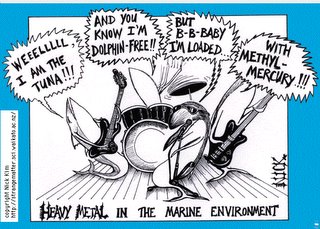
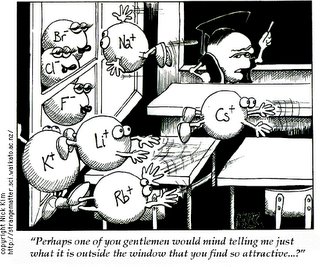
www.WebElements.com - an online periodic table, but not just any online periodic table, as this one has funny cartoons with some of the elements! Two that made me laugh! (yes, I am as geeky as you think I am)
www.BlackMask.com - FREE books online! All pre
http://www.adobe.com/epaper/ebooks/ebookmall/main.html - Another site that tells you where to find free books!
www.ScienceNews.org - They definitely have some presuppositions about certain topics (for example, they tend to side with large corporation food industry) so you have to read carefully to see where they are basing their articles on opinion rather than truth, but somewhat interesting nonetheless.
www.Boundless.org - Relevant articles about culture & life
www.NashBar.com - a very good place to buy bike things
www.Oriland.com - fun origami site
www.BlackMask.com - FREE books online! All pre
http://www.adobe.com/epaper/ebooks/ebookmall/main.html - Another site that tells you where to find free books!
www.ScienceNews.org - They definitely have some presuppositions about certain topics (for example, they tend to side with large corporation food industry) so you have to read carefully to see where they are basing their articles on opinion rather than truth, but somewhat interesting nonetheless.
www.Boundless.org - Relevant articles about culture & life
www.NashBar.com - a very good place to buy bike things
www.Oriland.com - fun origami site
Monday, January 02, 2006
Making money with your blog?
I'm sure all of the real bloggers know about this already, but did you know you can make money on your blog by placing ads? (see: http://help.blogger.com/bin/answer.py?answer=1217). First, I wonder if this might be annoying to the 1 or 2 people that actually visit my blog. But then then I think it would be neat to make money, but then I would be supporting materialism/commercialism/blah. Hmmm. So something I haven't thought of before, have you?
Thursday, December 22, 2005
Kindred Food Experience
I was at the local health-food store last night (buying ingredients for the organic fudge I'm going to make for my family, yes I know, "organic" and "fudge" probably don't go together, but I thought it would be better for us than traditional chemical-laden fudge...) and the man at the register saw my chocolate chips and asked, "So, are you going to use those in something or just eat them? Because I always keep a bag in the freezer and have some every time I pass by." And I thought I was the only one!
Tuesday, December 20, 2005
If you could only eat one food for the rest of your life...
What would it be? I have thought about this as I observe dogs eat. They get so excited each day for the same thing. Is there one food that I could get really excited about every day? I suppose it would be difficult to find something that was nutritionally complete though.
Friday, December 16, 2005
I am officially the biggest dork I know
Yes, really. I received an email today from someone at my church saying that "college and young adult people" would be watching a football game at the church (our home-town college is at some super-championship thing). Now, going somewhere where I don't know anyone to watch a football game (I don't like football) terrifies me, but I thought it would be good to make some friends and pretend to be social. I even made some guacamole to bring (which I admit was kind of a security blanket...holding guacamole makes me feel secure, yes I have problems). So I get there, set down my guacamole and have a set. After 15 minutes it becomes clear that everyone is either in junior high, high school or early college. There are a few older people there, but everyone is watching the game. So whatever prospect of meeting people seemed somewhat hopeless at that point. And so I leave! I know, I shouldn't have left, that was stupid of me, but I got scared and didn't know what else to do. A complication: my guacamole was in one of my housemate's bowls, but I couldn't take my food (that I just brought) with me, so I left it there, went to Wal-Mart and bought a new bowl. Yes, that is why I am the biggest dork I know.
Bible Fun
In Song of Solomon 6:6 the handsome lover is talking about some of the reasons he finds his bride-to-be so lovely:
"Your teeth are like a flock of ewes that have come up from the washing; all of them bear twins; not one among them has lots its young."
Isn't that the most romantic way you've ever heard someone say, "Your white teeth are great, and none of them are missing!"
So anyway, I just thought that was funny.
Tuesday, December 13, 2005
Monday, December 12, 2005
Friday, December 02, 2005
Good comment response
I wanted to thank the good commenters of my last post, I appreciated all of them. And it was especially exciting to see that someone other than Joanna or Rachna has visited my blog! It is good to hear about how other churches are. I think I have been disappointed and cynical about the one I am currently attending lately.
Monday, November 21, 2005
Blog for my Faithful Readers
I thought since Josephina has a link to me, I should write every now and then…
I am sorry to disappoint, but I just don't have very many thoughts to share. However, I thought of something I have been thinking about lately that I could write down.
The other day at church, the minister/pastor/person-at-the-front was commenting on how energy costs would be increasing this winter and how everyone would probably have to expect to pay more money for their heating bills. This is what I was thinking in my head, "Soon they will mention a way for people to be supported during this difficult winter - perhaps a special offering to help pay for heating bills or something like that." Therefore I was not expecting what would come next, "Since heating costs will rise this winter, we need to make sure to be ever-faithful in our tithing, because we also need to heat the church." (Not exactly what they said, but the same idea). Yikes that frustrated me.
Why is it necessary for people to help pay to heat a (very) large building that is probably only used maybe 20 hours a week? Most homes have someone (maybe only a pet) in them most of the day long while I have had sanctuary lights turn off on me while conversing with a fellow church-goer after church so they could lock the doors and close up shop!
Now, this issue would not be an issue if another idea of mine was implemented. A short story to illustrate my point:
It is a cold Saturday evening, with first snowflakes of winter beginning to swirl about the streetlights. Walking down the empty street is a (homeless man/teenager kicked out of home for the night/poor college student/enter needy person of choice here). Hands in the pockets of his too-thin coat, he walks quickly down the street, aiming for no particular destination but simply to keep warm. He sees a woman ahead, small plastic letters at her feet. She seems to be putting them on a signboard of some sort. "First Christian Church" the signboard says. Not wanting attention, he puts his head further down into his chest and starts counting the sidewalk cracks.
"Good evening!" the letter woman calls out. Disappointed he has been noticed, the man raises his head slightly, still hoping it was someone else the woman was talking to. "You, sir?" She tries again. He has definitely been found out and looks up once more and meets the gaze of this woman, putting letters on the signboard. "It sure is a cold one tonight, isn't it?" she says, looking at his hands in his pocket. He nods, acknowledging her but continuing to walk quickly, hoping to pass her and the conversation he doesn't want to have. "You know, I was putting up this sign, I meant to do it earlier, but have been busy all day. It's about a special service we are having tomorrow morning. It's going to be great! We're even having a potluck lunch afterwards." He nods again, trying to walk more quickly, still hoping she will stop talking soon so he can continue on his journey. "Maybe you would be interested in coming sir? It starts at 8 AM. Oh, and don't be worried about dressing up, we're very open here and welcome all types, not that you are any particular type. It's just, we want everyone to feel welcome. You know, it's supposed to be a cold day tomorrow too, so even if you stop by just to have lunch or want to be in a warm place with other people, please feel welcome to come."
Well, I'm not very good at story telling so I will stop there, but basically, wouldn't it be nice if the church could actually be open to people in need at all times, not just on Sunday morning? Someone is paying to heat these huge buildings week-round and no one gets to use it! Very disappointing. I think they should offer "free housing" for anyone who wants it. Tenants could work for their rent, maybe 5-10 hours a week, cleaning, kitchen duty, I don't know. I'm sure there is opportunity to be taken advantage of, of course, but it still seems like a better display of God's love in action than what I currently see.
Well that probably wasn't very well formed…but those are some thoughts from today...
Monday, August 22, 2005
A nychthemeron in the life of Julia
4:30 AM – wake up and realize I still have 1.5 hours to sleep!
6:00 AM – wake up & hit the snooze button :(
6:15 AM – Get up
6:30 AM – travel to work
7:30 AM – start working
10:00 AM – start blog entry for today upon learning new word, nychthemeron
Monday, August 15, 2005
First sock day :(
Today was the first day (since probably May) that I have worn socks :( Fall has officially begun.
Goodbye tanned toes!
Farewell foot freedom...
Wednesday, July 27, 2005
Plucky woman victorious again!
I rode my bike across the state of Indiana last Saturday, 168 miles!! Wee-hoo! It is pretty amazing to see what this weak body can accomplish. God has been so gracious to me, as I learn to be healthy...
Friday, July 08, 2005
New books to read...
The Female Cyclist
Apparently I, too, can become a world-class cyclist!
Beyond Sex Roles by Gilbert Bilezikian
I was interested in this book when I bought it, but I am not sure if it will address current questions I have. I plan to read it anyway in my “spare time”
Captivating by the John and Stasi Eldridge
I am skeptical about this one...the cover is pretty and I would like to be captivating, but I’m just not sure about it...
I have a few others too, but cannot remember their names :(
Friday, July 01, 2005
New baby!
Tuesday, June 28, 2005
Plucky woman wins again!
Plucky Woman vs. Wimpy Woman
News report: Plucky Woman was victorious over Wimpy Woman this past Saturday morning! Wielding powerful weapons of bad weather reports and the fearful “you can’t ride your bike in the RAIN!” Wimpy Woman engaged Plucky Woman in a fierce battle in the early morning. However, Plucky Woman surprised the enemy with a new raincoat and a cheerful disposition and rode 60 miles to victory in what turned out to be a gentle Iowa rainstorm....more news to follow as the story progresses.
Monday, June 20, 2005
Mutual submission or hierarchy in the trinity?
What do you think? Do you believe the Son submits to the Father? Or that they mutually submit to one another? Or do you think something else?
I have just discovered there are different views on this and would like to see what my faithful readers think :)
Saturday, April 02, 2005
Swiss Family Robinson
Has anyone (ok, J.) read this book? I started it a while ago and like it, but the "colonialization" mentality of the family is somewhat disconcerting. Though they seem to have an appreciation of the native Island they are stranded on (new foods, materials, etc.) they still strive to transform this island into their native land. It is probably the same thing we would all do though?
Thursday, March 03, 2005
Add a story...
Wispy clouds formed a lattice of blue and white in the warm spring sky, much like Grandmother Rebecca’s picnic tablecloth from last Fourth of July. The emerald stalks of grass pushing their way to the heavens competed with the small seedlings in the side garden, already gaining their freedom from the dark soil into the warm daylight. Puah was trying to absorb it all; the sunlight, the blossoming scents of spring but most of all the colors, the vibrant and delicious colors. For she knew her world would soon be filled with an oppressing darkness.
Well, faithful readers (er..reader!) I have started a story, and I request you add to it. Puah is the name of one of the Egyptian midwives that did not obey the Pharaoh when he told them to kill the baby Hebrew boys. God blessed them. I thought it was a courageous name, and could not remember the name we chose for our heroine :( Sorry, it’s a little dramatic. You can start a better story if you like :)
Tuesday, March 01, 2005
My thesis...
Typing typing typing
All a blur to me
Eyes are growing weary
Though not much to see
For my thesis is just
A ram-buh-ling mess (needed the 5 syllables!)
I would much rather be
in a dancing dress.
:) A poor poem, but it adequately reflects my feelings.
All a blur to me
Eyes are growing weary
Though not much to see
For my thesis is just
A ram-buh-ling mess (needed the 5 syllables!)
I would much rather be
in a dancing dress.
:) A poor poem, but it adequately reflects my feelings.
Subscribe to:
Posts (Atom)